Archimedes
-
The fourth installment of #EuropeanBios is going to be super short because it's about Archimedes (287 - 218 BCE) and it turns out we know almost nothing about the guy except that he was hella smart and invented a bunch of shit.
-
We're not even sure of his name. "Archimedes" means "Master of Thought" and so, like Plato before him, that was probably a nickname and not his given name. We do know he was from Syracuse in Sicily and lived pretty long, probably to the age of about 75.
-
Like most of the ancient European philosophers we know anything about, his ability to spend all his time thinking was the result of not having to work, probably the result of wealthy benefactors — he seems to have been a childhood friend of the king of Syracuse at the time.
-
As I was hoping, there are fun and unexpected connections between the people I've picked in my timeline. Archimedes studied and did a lot of original work at Alexandria in Egypt, the one Alexander the Great founded in the last chapter.
-
After studying, Archimedes returned to Syracuse. Syracuse was a very wealthy city-state, important to local politics at the time and so constantly under threat from various people including the Romans. Archimedes turned out to be key to their defense!
-
While Archimedes did shit-tons theoretical math like geometry and calculus, he also did a bunch of extremely practical engineering like a catapult that could sink ships from a distance, and a giant claw that could pick a boat up and drop it, causing it to shatter.
-
Famously, he is supposed to have invented a set of parabolic mirrors that could focus the sun's rays on attacking ships and set them on fire. Given the quality of mirrors available at the time, there is a lot of debate about whether this really happened.
-
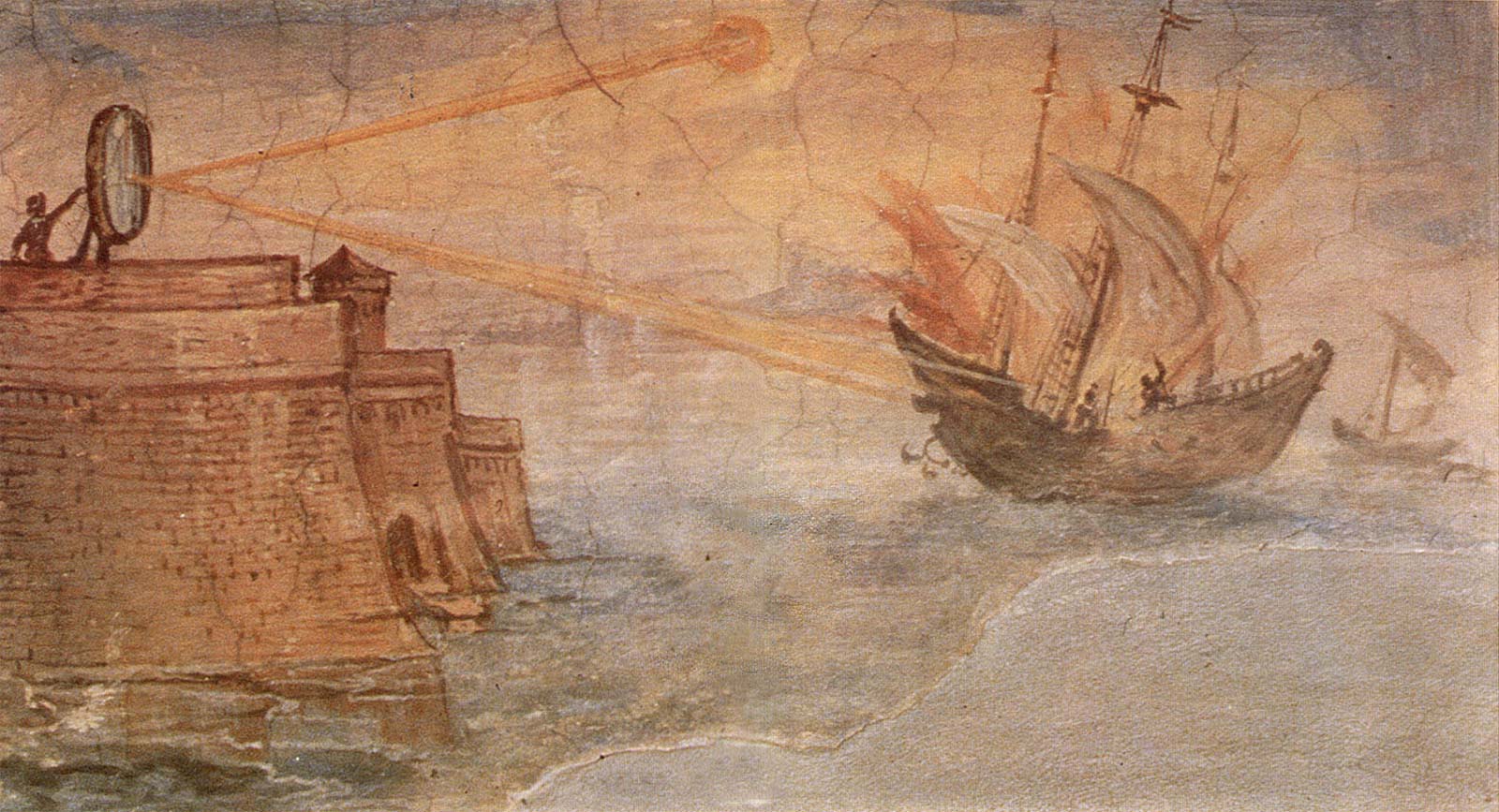
Nobody is really clear on how many ships or how many mirrors were involved. Public domain -
There have been numerous attempts to re-create it with multiple mirrors, particularly dark sails, etc. and it's really quite tricky to do. If it ever worked, its success was probably exaggerated. There's a MythBusters episode about it.
-
Even more famously, Archimedes' Principle, named after him, is a way of determining the volume of an irregular object by submerging it in water. According to historical accounts, Archimedes first used this to try and work out if a king's crown had been made of pure gold or diluted with silver.
-
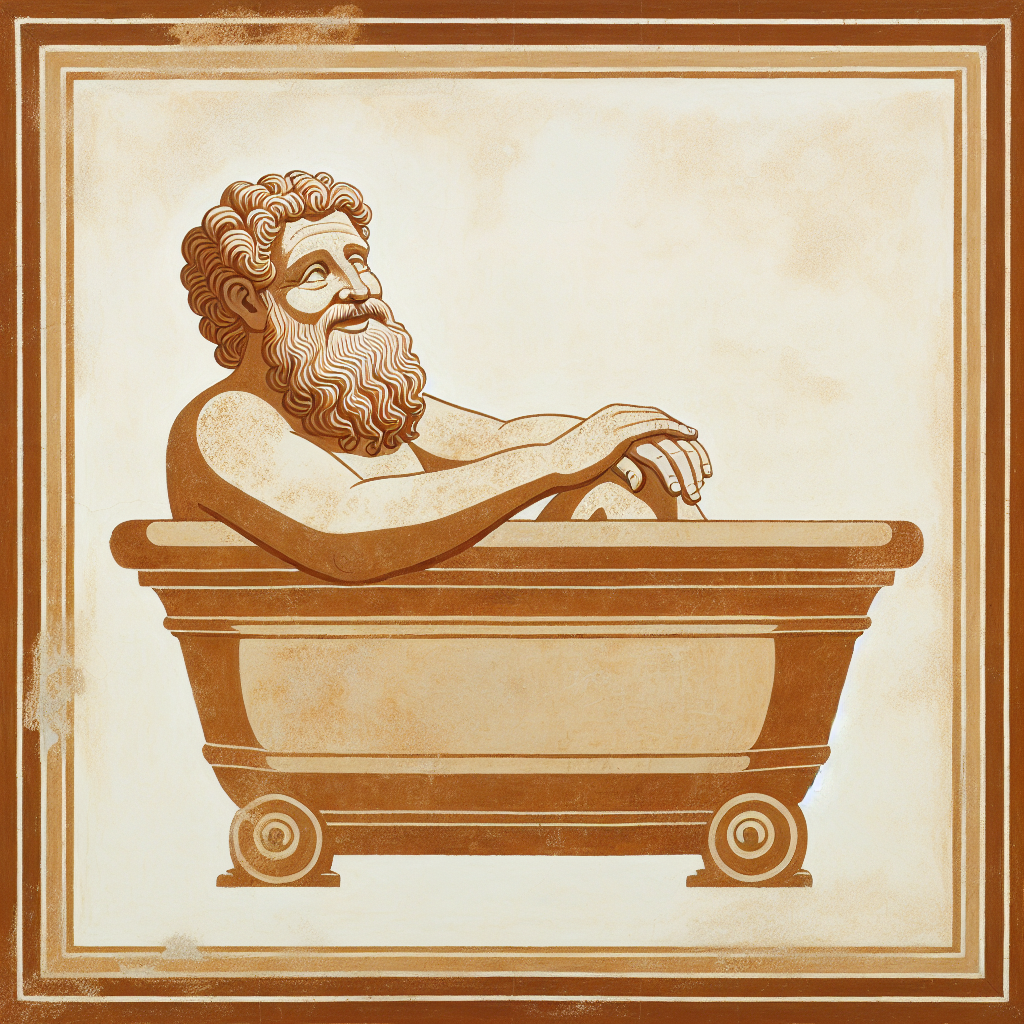
The idea for measuring volume by displacement allegedly came to Archimedes in the bath, when he noticed that the water level rose and fell as he got in and out. He is supposed to have got so excited about this that he leapt out of the bath, shouting "Eureka!"
-
The person who credits Archimedes with the discovery of his principle was writing more than 200 years later, so the accuracy is debateable at best. He may have discovered the principle. That he discovered it in the bath is less likely, the eureka thing almost certainly false.
-
Eventually in 212 BCE the Romans attacked Syracuse and despite Archimedes' machines they were eventually overrun and Archimedes was killed. And that's basically all we know!
-
Part of why we don't know much about Archimedes is that unlike some of the other ancient philosophers he wasn't very famous at the time. Nobody understood much of the math he did until 600 years later, by which point a lot of material was lost.
-
One of the few really good sources we have about Archimedes is a famous book called the Archimedes Palimpsest. This was a book of religious instruction that was made from goatskin parchment that had previously had another book on it and been erased and reused.
-
The book it had been before it became a religious book was a copy of Archimedes' works, and with the right tools and x-rays it's possible to still read the original book underneath. It had a long and complicated history of ownership, but eventually it was bought by... Jeff Bezos.
-
What? Yes. Jeff Bezos paid $2 million in 1998 for it, and then loaned it to a museum. He also apparently created and funded archimedespalimpsest.org, where you can see high quality x-ray scans of the whole book. Weird!
-
The final fun connection to this project is that the reason the Romans invaded Syracuse in the first place is because they needed to secure it against becoming a base for the guy they were really afraid of: Hannibal, subject of the next chapter.
- Previously: Alexander the Great
- Next: Hannibal
- Full list
Text and images copyright © 2020-2023 Laurie Voss
except where indicated
except where indicated